Field Demonstration of 150m-1° Micro Flow Field Leakage Monitoring and Tracking Detection Equipment at Qingyaoshan Dam
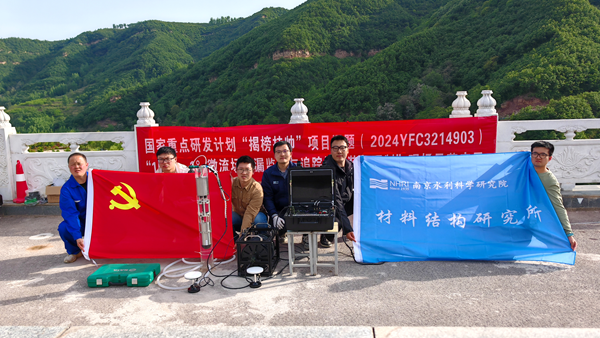
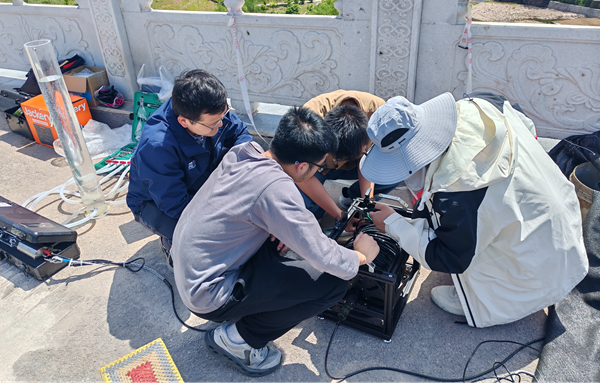
In accordance with the mid term milestone assessment schedule of the subproject Development of 150m-1° Micro Flow Field Leakage Monitoring and Tracking Detection Equipment under the project titled Key Technologies for Leakage Diagnosis and Remediation of Asphalt Concrete Core Wall Dams under Complex Dam Construction Conditions, a project under the Open Competition Mechanism for the National Key R&D Program during the 14th Five Year Plan period, from April 22 to 26, 2026, the task force from Materials and Structural Engineering Department of NHRI went to the Qingyaoshan Dam in Luoyang City, Henan Province, carrying out a field demonstration application of micro flow field monitoring and leakage detection.
The Qingyaoshan Reservoir has a total storage capacity of 9.6 million m³, and is a multi purpose project primarily for water supply, with flood control and irrigation as secondary functions. The dam is a rockfill dam with a roller compacted asphalt concrete core wall; its maximum height is 76.1 m, and the crest length is 206.44 m. The open spillway is located on the right dam abutment, with a control section bottom width of 48 m and a total length of 282 m. The water conveyance tunnel and intake tower are situated on the left dam abutment; the tunnel is 112 m long and has a water diversion capacity of 1.8 m³/s. In recent years, several seepage points have appeared on the downstream slope of the dam.
The task force conducted a site survey of the dam. Considering the characteristics of existing borehole cores and water levels in the boreholes, they selected the borehole K0+125 at the dam crest as a test borehole and designed a leakage detection scheme. The self developed prototype of the micro flow field monitoring and leakage detection equipment includes an acoustic flow velocity sensing module (dual channel in time domain and frequency domain), a deployment/retrieval module, a spatial positioning module, and a flow velocity interpretation module. Through static flow velocity calibration of the prototype, layered sensing of water flow velocity in the borehole, and three dimensional flow velocity and direction interpretation, the prototype achieved the detection of micro flow velocity at 2 mm/s, with a flow velocity resolution exceeding 0.1 mm/s. With combination of the local velocity correlation of the micro flow field in the borehole with a leak point localization model, the central elevation of the leakage point was determined. Through the field testing, the adaptability of the acoustic flow velocity sensing module to deep borehole detection was resolved; the difficulties of accurately identifying the micro flow field inside the dam and precisely locating leakage points were overcome; and the maturity and applicability of the self developed technology and equipment were advanced.
Materials and Structural Engineering Department of NHRI leads the overall research of this subproject and undertakes its core research work and performance indicators. This field demonstration tested and validated the self developed technology and equipment under real world conditions, fully achieving the key technical indicators at the subproject’s milestone node, thereby laying a solid foundation for the mid term assessment.
